
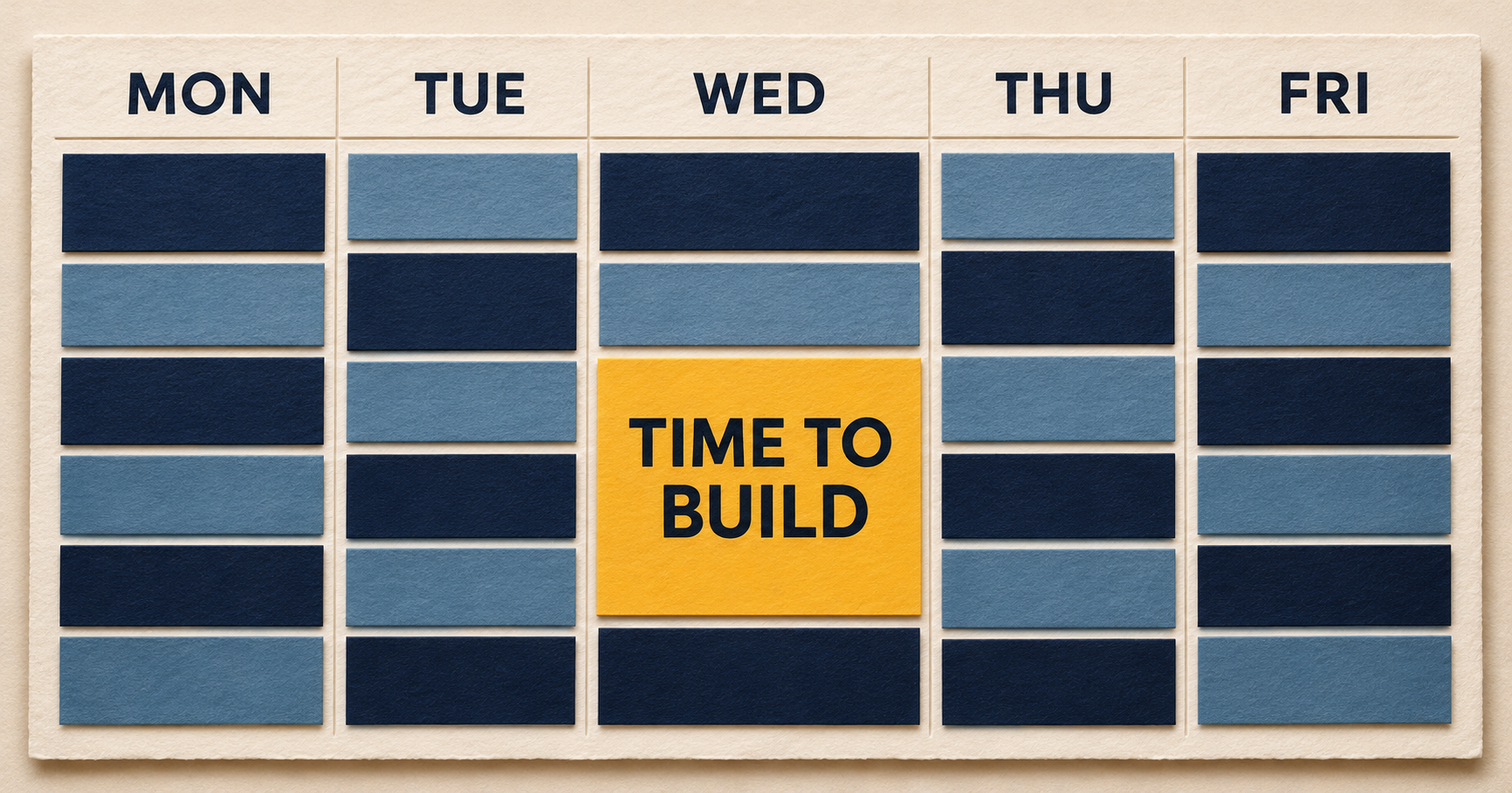
Automation can create an opening. Leaders can use it to put experts on harder business problems—and give selected teams the time to experiment and innovate.
A new client can fill the hours AI just freed. Before you commit that time, look at what your best people keep doing for one customer at a time.
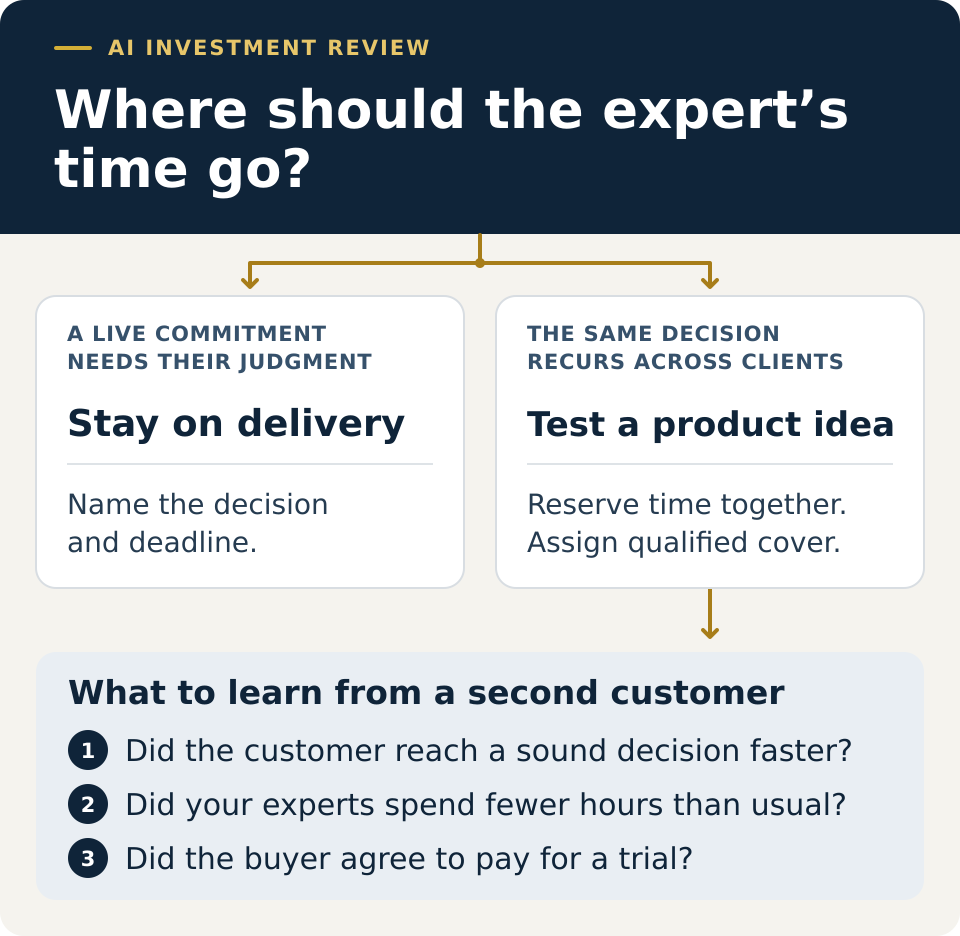
If a live commitment depends on their judgment, give that customer the time. If different customers keep paying for help with the same decision, give an expert and a builder time together to find out whether customers could get the result from something you can sell more than once.
On October 26, 2026, Gartner reported that 21% of the time freed by AI went to more innovative work, citing its second-quarter survey of 1,865 employees. For an executive, the choice is what an available block of expert time can buy. A difficult client decision, an additional engagement and a test of a new offer all make different demands on the same people. Gartner’s October research
After the September 11 attacks, Krishna Bharat saw people searching Google for current news and finding older stories. Google’s retrospective shows an internal test of Google News from December 2001, ahead of its launch the following September. People came to Search with a familiar task and exposed a need for something Google could offer separately. Google’s retrospective
In its IPO letter, Google identified News as one of the products prototyped in time the company encouraged employees to spend on ideas for Google. It also said it expected most of its resources to go toward improving search and advertising. The harder question for a smaller firm is which idea deserves time from someone a customer already counts on. Google’s IPO letter
1. Find the decision customers keep bringing you
Start with the moment the customer needs the expert. A team may prepare the same kind of report for every account, yet the report may support a different decision each time. Look across a few engagements and ask three questions.
- What did the customer decide? Describe what they could do after talking with the expert. The report itself may tell you little about why they called.
- What made the decision possible? Identify the evidence the expert used and check whether the next customer can get it without someone preparing it for them.
- Where does judgment still matter? Compare the calls the expert could explain with a rule and the exceptions they had to resolve through a conversation.
Suppose an implementation team keeps getting calls about whether a customer can launch with an open item. A missing sign-off may block one launch. A change that the customer explicitly deferred may leave another launch on schedule. The lead knows where the approval is recorded and what makes a deferral legitimate.
A useful tool could put that evidence in front of the customer’s project owner and route unresolved cases to the lead. If customers define readiness differently, the expert can help the builder identify which rules customers could set for themselves. Put the boundary for specialist help in the offer so you can estimate what it will take to serve the next account.
2. Put the trial on the delivery calendar
An analyst who finishes the preparation sooner may get the facts to the lead earlier. The lead can still have a full week of customer decisions. Team-wide hours saved can make an experiment look staffed on paper while the person who understands the recurring problem has no time to work on it.
Before you commit to a trial, check the work already on that person’s calendar.
- Find usable time. Reserve a block when the expert and builder can work together. Spare minutes after a review do little when the builder is committed elsewhere.
- Set one question. Decide what you want to learn about what the customer could do with less specialist help. Confirm that a customer participant can join and that the team can use the evidence the test depends on.
- Move a delivery assignment. Name a qualified colleague who has the time and authority to take it. A person who can answer routine questions may still need the expert to settle a disputed decision.
Sometimes the best use of AI savings is to give the expert time to investigate a difficult customer problem before a deadline. The report can take less time to prepare while the final judgment deserves more attention.
If the customer depends on that judgment and the team cannot cover the work, give the live commitment priority. Pick a date to reconsider the experiment when the people it needs can work together.
3. Read the second customer’s evidence
Use the first customer to learn what a useful result looks like. The expert may know the account well enough to make an early version work by supplying context, preparing records or correcting an ambiguous result during the session. Record that work so you can see whether the next customer needs it too.
Ask a second customer facing the same decision to try the approach with the information they ordinarily have. Use three checks to decide what the result is worth.
- Did the customer reach a sound decision faster? Compare the decision they made and how long it took with what they get from their usual process.
- Did your experts spend fewer hours than usual? Compare the hours your experts spent on setup, questions and exceptions with what similar work usually takes. If the team still has to rebuild the workflow or review every result, the trial may point to a better way to deliver the service.
- Did the buyer agree to pay for a trial? Spell out what they get, what their team has to do, what support you provide and what the trial costs. Look for a commitment of money and staff time that you can weigh against the cost of serving the next customer.
Look closely at what the buyer agreed to purchase. If the price includes an expert reviewing every result, you have learned something about demand for that service. If the buyer accepts an offer that calls on the expert only for exceptions, you have a clearer basis for deciding what to build. A useful result that carries over with less specialist work and a buyer willing to pay can justify the next investment.
At your next AI investment review, put one live customer commitment beside one decision customers repeatedly pay you to help them make. Decide which one gets the expert’s time and what you expect to see at the next review.